Yes, as a private individual resident in Sweden, you can buy a car in Switzerland for your own use and register it here.
Yes, as a private individual resident in Sweden, you can buy a car in Switzerland for your own use and register it here. Treat the purchase as an import from a country outside the EU customs and VAT area: secure the original documents, appoint an exporter and declarant, and plan lawful transport.
Do not make the final payment until the VIN, the seller’s right to sell, the document chain, the vehicle’s condition, and the customs and registration route all align. Allow for standard customs duty and import VAT until any preferential origin for the vehicle and acceptable proof have been confirmed. 1 2 3
The decision before payment
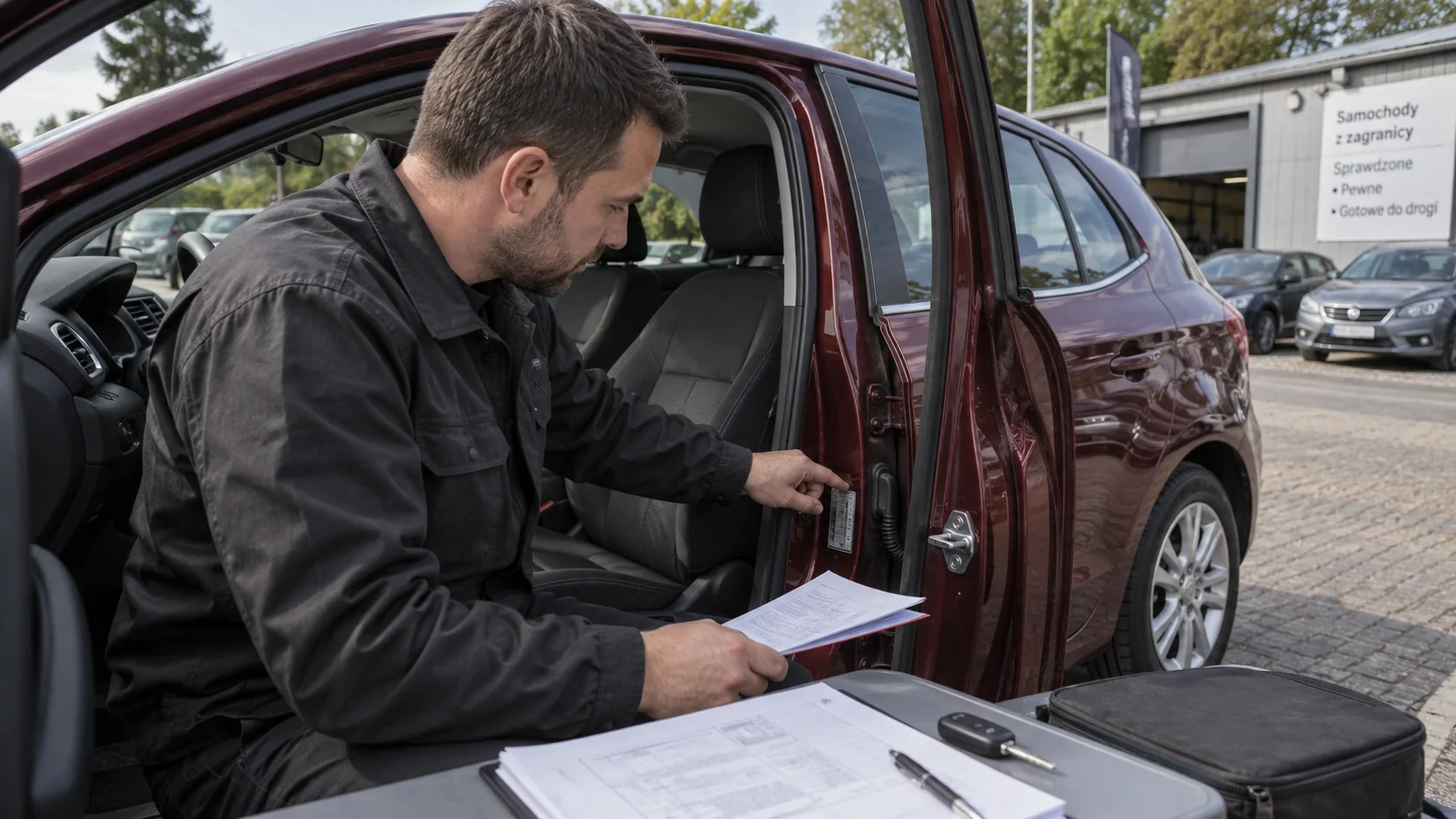
Compare the VIN on the vehicle with the purchase document and the Swiss registration certificate. Request every issued part in the original and check the service and inspection history. Export documents alone do not prove a complete ownership, finance, damage or service history. A pre-purchase condition inspection replaces neither verification of origin, registration inspection nor any periodic roadworthiness test. 4 5 6
The agreement should state the vehicle, price, currency, delivery terms, original documents, exporter, declarant, transfer of risk, and what happens if export, customs clearance or registration fails.
| Decision point | Proceed when | Pause when |
|---|---|---|
| Vehicle and seller | The VIN matches the vehicle, agreement and original documents; the seller’s right to sell has been checked | Identity, ownership, finance or history cannot be resolved 4, 5 |
| Export and customs | Exporter, declarant, customs office, EU entry point and clearance evidence are planned | A plate or an agreement is claimed by itself to complete the export 4, 1 |
| Preferential origin | The customs authority has confirmed the vehicle’s rule, proof and conditions | Zero duty relies only on the country of registration, make, assembly or CoC 7, 2, 3 |
| Transport | The carrier’s assignment and customs responsibility are in writing | Self-driving lacks verified plate, insurance or route cover 5, 8 |
A CoC may be useful later, but it does not prove preferential origin. Nor do the country of registration, the seller’s address, make or place of assembly. For reduced or zero customs duty, the exporter must arrange vehicle-specific proof of origin before export, and the customs authority must accept the claim under the agreement. The Commission cites EUR.1, EUR-MED, and invoice or origin declarations as common forms of proof. The 6,000 EUR limit for a declaration by an unregistered exporter is general; check the rules, validity, and direct-transport or non-alteration conditions of the current agreement. 7 2 3
Swiss export and safe transport
Permanent export must be declared proactively at a Swiss customs office for commercial goods. The case includes the registration certificate, even if cancelled, an identity document, the export customs declaration and, where applicable, proof of origin. A purchase agreement, deregistration or an export plate alone does not complete the export. Arrange the customs office and declarant before departure. 4
Export plates are decided at canton level. Zurich is only an example: it specifies an original registration certificate and original identity or driving-licence document. For an out-of-canton vehicle under 3.5 tonnes bought in Zurich, the purchase agreement is also specified; a vehicle with technical defects must first be presented to the road traffic office. The export plate includes collective insurance and is valid until the end of the month, for no more than 35 days. It cannot be extended, repeated or transferred to another vehicle. 5
If driving the vehicle yourself, obtain written confirmation of the competent canton, expiry date, driver, the insurance’s geographical validity and recognition of the plate along the route. If any link is missing, vehicle transport is the cautious option.
| Stage | Chosen solution | Checkpoint |
|---|---|---|
| Collection | The carrier loads the vehicle | VIN, condition, keys, original documents and receipt are documented 4 |
| Swiss export | The carrier follows the agreed customs plan | The competent customs office, exporter and declarant are confirmed before departure 4 |
| First EU entry | The vehicle is declared under the chosen clearance or transit plan | Purchase value, registration certificate, customs reference, VIN and any MRN are retained 1, 8 |
| Delivery in Sweden | Unloading at the agreed storage location | The arrival date and insurance status are noted; the vehicle is not driven without valid authorisation 9 |
Common transit may be used between Switzerland and the EU, but does not arise merely from crossing a border. If it is proposed, you need a declarant, customs offices, a guarantee, NCTS or MRN documentation, and a plan to discharge the procedure. 8
Customs duty and VAT at the first EU entry point
The vehicle must be declared when it first enters the EU. Bring the purchase and value documents together with the foreign registration certificate. The customs office may be outside Sweden; choose the entry point, procedure and declarant before transport, and keep the clearance evidence. 1 10
Swedish Customs states a standard 10% customs duty for private passenger cars on the purchase price plus freight, insurance and handling to the EU border. Where import clearance takes place in Sweden, import VAT is 25% on the same value including duty. If clearance takes place in another EU country, the clearing customs authority must confirm the VAT treatment; do not assume a foreign percentage. An amount requires an agreed price, transport costs, classification and a decision on any preference. Collectors’ vehicles, other reliefs and a valid origin claim are assessed separately. 1
The clearance document must be linkable to the vehicle, for example by VIN. For Swedish clearance, the copy for verification of origin must contain the Swedish customs reference and vehicle details. For clearance in another EU country, attach that country’s document. 10
Swedish verification of origin and registration
After arrival, the intended Swedish registered owner applies for verification of origin. This is the first registration step and the fee is 1,240 kr. For a previously registered vehicle, the purchase document, customs-clearance evidence and the original Swiss registration certificate with all parts are required. If the owner changes before entry in the road traffic register, the approval ceases to be valid; the new owner applies with their purchase document. 6 10
Only after approved verification of origin may you book a registration inspection or individual approval. The inspection company checks technical identity, environmental and road-safety requirements, and registered vehicle details. It may require further technical documents depending on previous registration, type approval, CoC, modifications and category, and determines whether a periodic roadworthiness test is needed. A foreign report or a pre-purchase inspection is not a Swedish registration decision. 6
After an approved registration inspection or individual approval, the vehicle receives a registration number. The registration certificate and plates are sent only to the owner’s registered address in Sweden. Where insurance is required, Swedish compulsory motor third-party liability insurance is needed before the vehicle is activated for road use; vehicle-tax information follows activation. 6
When may the vehicle be driven in Sweden?
Without Swedish temporary registration, the vehicle may be driven for no more than one week from arrival, only if the foreign registration is valid for unrestricted use and valid insurance covers the driving. The driver must carry a readable registration certificate. 9
After that, or immediately if the registration is not valid, the vehicle may not be used without temporary registration. A certificate for a booked inspection permits only the shortest appropriate route to and from the inspection; otherwise a trailer is required. Temporary registration is applied for with verification of origin, is valid for three months, and cannot be extended. Compulsory motor third-party liability insurance must be valid throughout all use. 9
With Swedish temporary registration, a vehicle from Switzerland has restricted use before an approved registration inspection: only the shortest appropriate route between the specified port, railway station, customs-clearance location, workshop, storage location or inspection. After approval, normal use is permitted for the remaining period if the vehicle has not been altered from its inspected configuration. Temporary registration does not guarantee final registration. 9
Budget without a misleading total
Add up the costs only once all mandatory items and the chosen transport branch have actual amounts. Self-driving and a carrier are alternatives, not duplicate costs. Include any periodic roadworthiness test and adaptation once the vehicle has been assessed.
| Item | Amount | Conditions |
|---|---|---|
| Purchase price | To be determined | Contract price and payment currency according to the purchase document 4 |
| Currency exchange and payment | To be determined | Exchange rate, fees and payment date from the chosen payment service |
| Pre-purchase condition inspection | Request a quote | Separate from the authorities’ origin and registration checks 6 |
| Export administration | Request a quote | Customs agent, declaration and documents under the chosen solution 4 |
| Export plate and foreign insurance | To be determined | Only if the vehicle is driven; the competent canton, period and territorial cover govern 5 |
| Vehicle transport | Request a quote | Chosen transport branch; scope, insurance and customs responsibility must be stated in the quote 8, 1 |
| Fuel, road charges and ferry | To be determined | Alternative self-driving branch; must not be added on top of the chosen carrier 5 |
| Customs duty | To be determined | Standard 10% on the price plus freight, insurance and handling to the EU border; preference or relief requires a separate decision 1, 2, 3 |
| Import VAT | To be determined | For Swedish import clearance: 25% on the customs value including duty; for clearance in another EU country, VAT treatment is confirmed with the clearing customs authority 1 |
| Verification of origin | 1,240 kr | Transportstyrelsen’s published application fee 6 |
| Registration inspection | Request a quote | Price and technical route are determined by the inspection company 6 |
| Any periodic roadworthiness test | Request a quote | Included only if required for the vehicle 6 |
| Swedish registration plates | To be determined | The current cost must be checked before ordering 6 |
| Swedish compulsory motor third-party liability insurance | Request a quote | Must be valid before activation where insurance is required 6, 9 |
| Repairs, adaptation and tyres | Request a quote | Based on the condition inspection and inspection requirements 6 |
| Vehicle tax | To be determined | Vehicle details and activation determine the amount 6 |
| Contingency | To be determined | Your own buffer for currency, logistics, documents and vehicle measures |
Set your own contingency for currency, customs value, technical requirements and repairs; it is not an authority fee.
Checklist from agreement to activation
| Check | Complete when | Status |
|---|---|---|
| Identity and seller | The VIN has been reconciled physically, in the agreement and in all originals; ownership and history have been reviewed | To be checked 4, 5 |
| Swiss export | The exporter, declarant, competent customs office and export customs declaration are arranged | To be checked 4 |
| Origin claim | The vehicle’s rule, acceptable proof, validity and transport conditions are confirmed | To be checked 7, 2, 3 |
| Transport and customs entry | The carrier, first EU entry, insurance, declaration and any transit discharge are documented | To be checked 5, 8, 1 |
| Customs-clearance evidence | The document states the correct customs reference and can be linked to the vehicle by VIN | To be checked 10 |
| Verification of origin | The correct intended owner has applied after arrival with the purchase document and all original parts | To be checked 6, 10 |
| Swedish inspection | Verification of origin is approved and the registration inspection or individual approval is complete | To be checked 6 |
| Lawful use | Registration, permitted journey, insurance and time limit are valid for every drive | To be checked 9 |
| Activation | The Swedish registration number, plates, compulsory motor third-party liability insurance and tax basis are dealt with | To be checked 6 |
Keep copies, but provide the required originals. Note the arrival date, insurance, plate expiry date, customs events and bookings so that a transport document is not confused with registration approval.
Frequently asked questions
Must I pay customs duty and VAT on a car from Switzerland?
The starting point is yes. Swedish Customs states a standard 10% customs duty for private passenger cars and, where import clearance takes place in Sweden, 25% import VAT on the customs value including duty. For clearance in another EU country, VAT treatment must be confirmed with the clearing customs authority. The final outcome depends on the vehicle’s classification, value, any relief, and whether valid preferential origin can be substantiated with accepted proof. 1, 2, 3
Does Swiss registration automatically give zero customs duty?
No. The country of registration, place of purchase, make, place of assembly or CoC does not prove preferential origin. The exporter needs to arrange the correct vehicle-specific proof, and import customs must accept it under the applicable agreement before you budget for lower duty. 4, 7, 3
Which originals are needed for Swedish verification of origin?
For a previously registered vehicle, the original Swiss registration certificate with all issued parts is needed. Also attach a copy of the purchase document and customs-clearance evidence with the correct customs reference and vehicle details, or the document from the EU country where the vehicle was cleared. 10
May I drive the vehicle in Sweden during the first week?
For no more than one week from entry, and only if the foreign registration is valid for unrestricted use, the insurance covers the driving and you carry a readable registration certificate. Otherwise, temporary registration or transport is required. 9
How may the vehicle be driven after the first week?
After the first week, or if the foreign registration is not valid, the vehicle may be driven only with temporary registration or a certificate for a booked inspection. The certificate is valid only for the shortest appropriate route to and from the inspection. Otherwise, transport on a trailer is required. With Swedish temporary registration, a vehicle from Switzerland also has only the specifically stated, restricted routes before an approved registration inspection. 9
How long is Swedish temporary registration valid?
It is applied for together with verification of origin, is valid for three months and cannot be extended. Compulsory motor third-party liability insurance must be valid throughout the time the vehicle is used. Therefore plan the whole inspection sequence within the validity period. Temporary registration is not a guarantee of final Swedish registration. 9
Is common transit automatic when the vehicle crosses the EU border?
No. If it is used, the actual declarant, customs offices, guarantee, NCTS or MRN documentation and discharge plan must be arranged. A border crossing in itself does not show that a transit procedure has been opened or discharged. 8
What happens after an approved registration inspection?
The inspection company enters the vehicle in the road traffic register and a registration number is allocated. Transportstyrelsen sends the registration certificate and plates only to the owner’s registered address in Sweden. Compulsory motor third-party liability insurance must be in place before activation where insurance is required; vehicle-tax information follows activation. 6
Pre-purchase inspection
CarAudit’s published country list does not include Switzerland. Ask whether the specific location and vehicle can therefore be covered; availability, price and timing must be confirmed.
Would you like to find out whether a pre-purchase inspection can be arranged? Switzerland is not on CarAudit’s published country list, so first ask whether the specific location and vehicle can be covered. An enquiry does not confirm availability, price or timing. 11, 12
Sources
- Tullverket — Buying or selling cars in another country
- European Commission — Preferential rules of origin arrangements list
- European Commission — Proof of origin
- Swiss FOCBS — Exportation of a vehicle from Switzerland
- Canton Zürich — Exportschild beziehen
- Transportstyrelsen — Vehicle import and verification of origin
- European Commission — Proof of origin
- European Commission — Customs transit
- Transportstyrelsen — Application for temporary registration: import
- Transportstyrelsen — Import from countries outside the EU
- CarAudit — Frequently asked questions, English
- CarAudit — Contact, English